

Homemade Sourdough Everything Bagels
I’ve been deep in bagel testing lately, and this is the version I finally stopped adjusting. After years of making bagels that were good but never quite met my standards, this dough gave me the chew, structure, and crumb I was aiming for. It’s the same base I use for my sourdough cinnamon raisin bagels—just taken firmly in a savory direction.
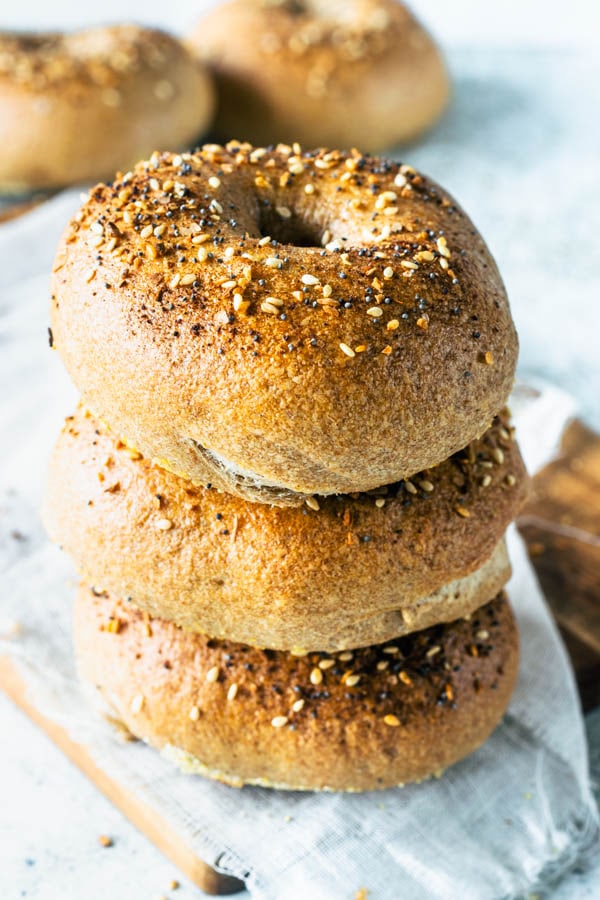
What convinced me was how consistently this dough performed. I baked the cinnamon raisin version, then turned around and made these everything bagels using the same formula, and both came out exactly how I wanted. That reliability matters to me, especially with sourdough, where texture and timing can drift if the dough isn’t dialed in.
This post may contain affiliate links. I earn a commission from qualified purchases. Please read our Privacy policy here.
You’re Going to Love These Bagels Because…
After countless failed attempts, I finally found a recipe that I love!
- The dough is stiff enough to hold its shape but still bakes up chewy
- The crumb stays tender without feeling fluffy or bread-like
- One base recipe works for sweet and savory bagels
- They’re sturdy enough for sandwiches but still great toasted
Key Ingredients & Why I Use Them
Sourdough starter
This recipe relies on an active starter for structure and flavor. I like how it brings depth without overpowering the dough.
Malt syrup
This adds a subtle sweetness and helps with browning. I’ve tested versions without it, and the crust just isn’t the same.
Bread flour + all-purpose flour
I use a blend to balance chew and tenderness. All bread flour was too tough for my liking; this combination hits the middle ground.
Vegetable oil
Just enough to soften the crumb without turning the bagels cakey.
Everything seasoning
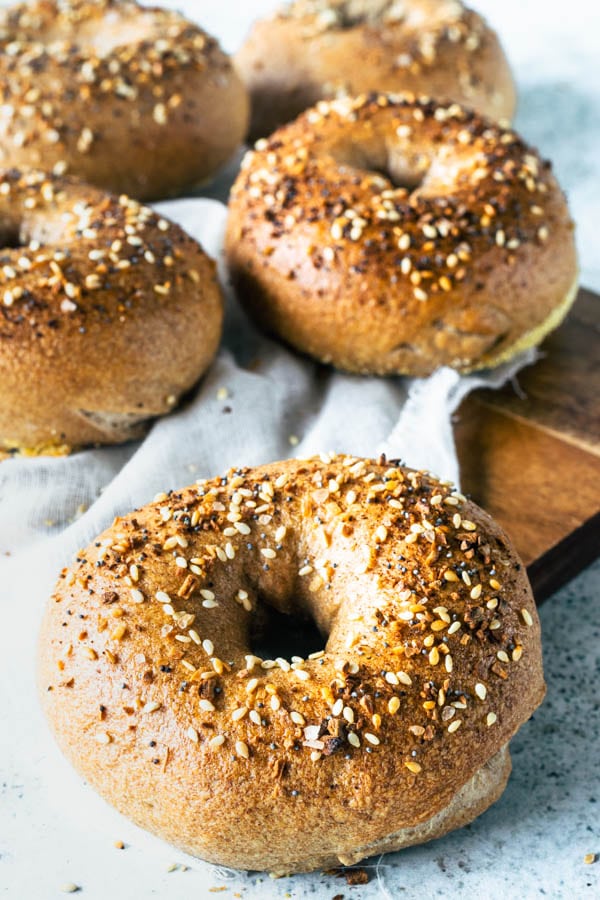
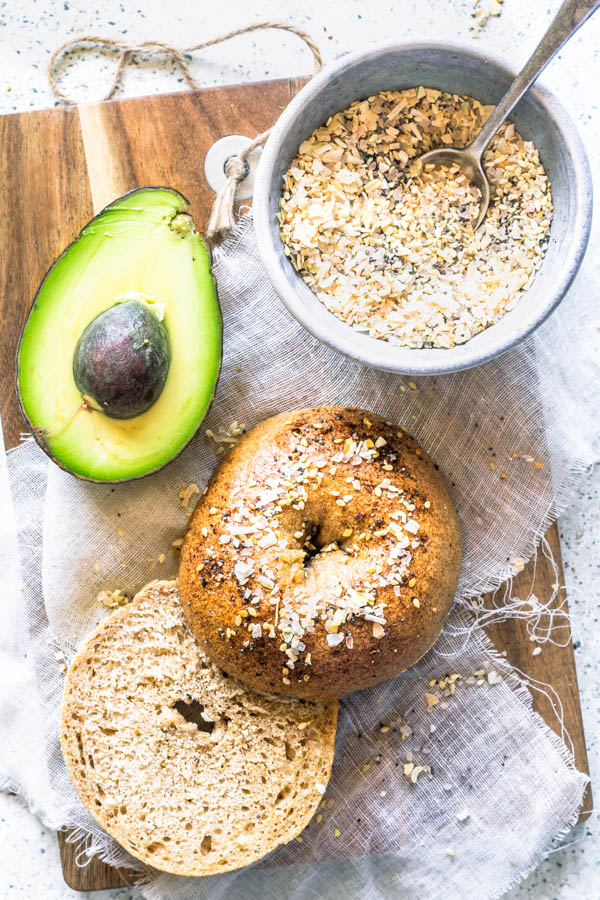
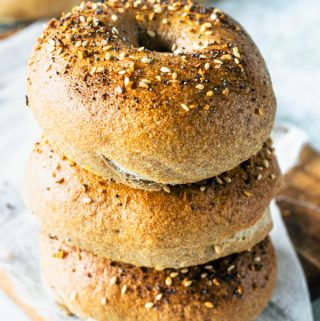
I don’t stick to a strict mix. I usually use sesame seeds, poppy seeds, dried onion, dried garlic, and coarse sea salt. This batch also included za’atar, which adds a tangy, savory note I really enjoy.
How I Make These Sourdough Everything Bagels
The full recipe card is below, but this is how I make them step by step and where I pay attention.
Step 1: Mixing the Dough
I start by mixing the sourdough starter, 1¼ cups of the water, vegetable oil, malt syrup, sea salt, and both flours in a large bowl. The dough will feel extremely stiff right away—that’s intentional. At this stage, I’m just making sure all the flour is hydrated. If I still see dry patches that won’t incorporate, I add the remaining ¼ cup of water a little at a time.
Then, cover the bowl with a damp towel and let the dough rest for 10 minutes. This short rest makes the kneading easier.
For kneading, I strongly prefer using a stand mixer. This dough needs at least 7 minutes of kneading by machine, and closer to double that if you’re working by hand. It’s dense and resistant, and that’s exactly why proper kneading matters here. This step is what gives bagels their chew.
Step 2: Rising & Shaping
When the dough is ready, it looks smooth but still feels firm and heavy. I transfer it to a lightly oiled bowl, cover it with a damp towel, and let it rise in a warm place for about 4 hours. If my kitchen is on the cooler side, I let it go closer to 5 hours.
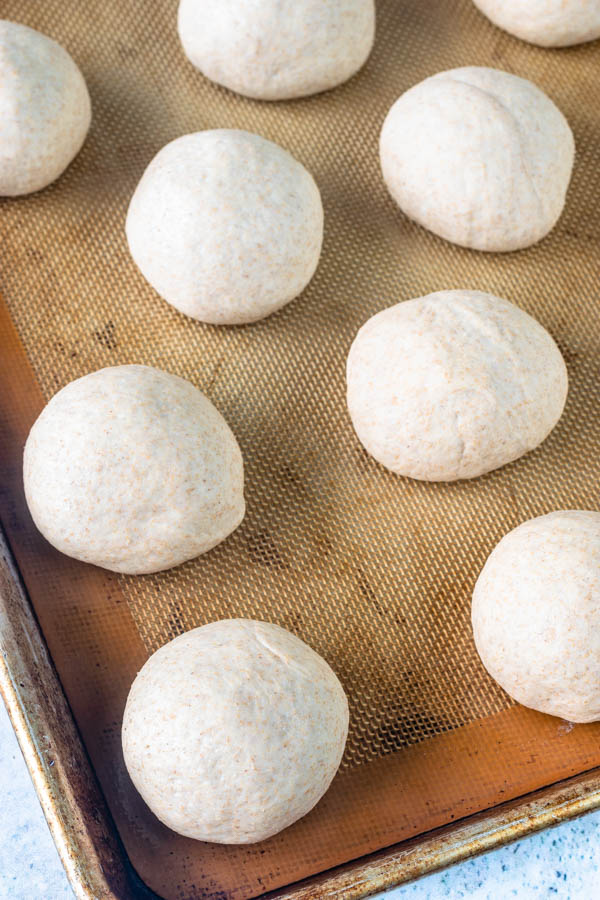
Once risen, I turn the dough out onto the counter and divide it into pieces. I usually portion mine at 100 grams each, which gives me about 14 bagels. I shape each piece into a tight ball by rolling it against the counter with my hand cupped, using the surface tension to pull the dough into itself.
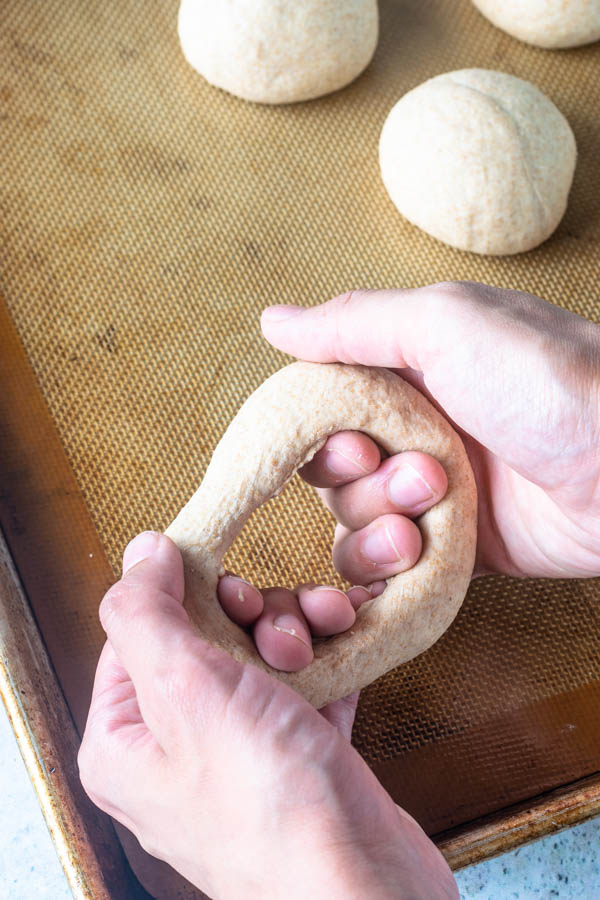
After shaping all the balls, I make the bagels by pressing my finger through the center of each one, then gently stretching the hole while rotating the dough in my hands. I focus on keeping the thickness even all the way around.
I place the shaped bagels onto two parchment- or baking-mat-lined sheets, seven per tray, cover them with a damp towel, and let them rest at room temperature for 1 to 2 hours. When the dough springs back slowly when touched, they’re ready.
Step 3: Boiling & Baking
I preheat the oven to 425°F and bring a large pot of water to a boil. Once boiling, I add baking soda. I boil the bagels in batches, being careful not to overcrowd the pot, for about 20 seconds per side. I avoid boiling longer than one minute total—any more than that and the crust can turn too hard.
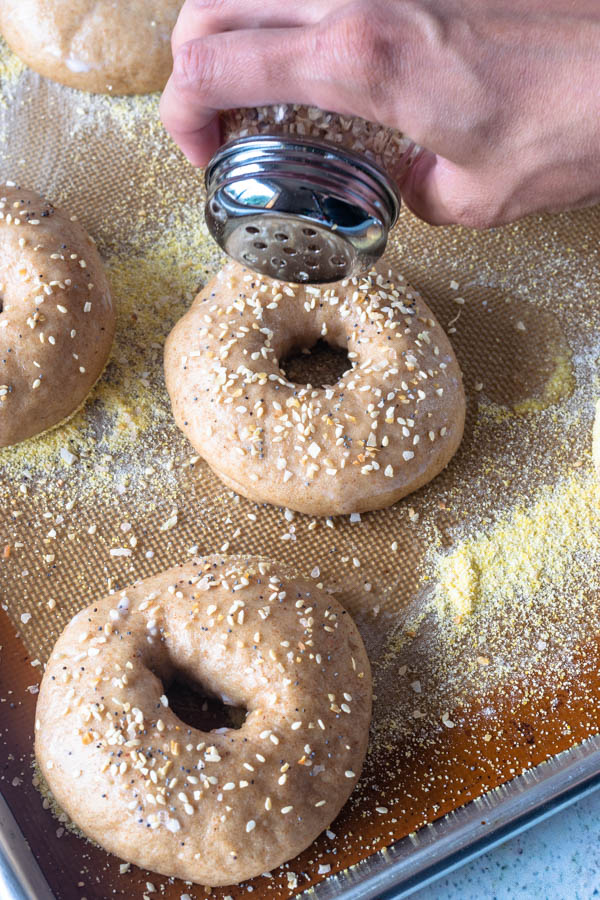
After boiling, I transfer the bagels to a lined baking sheet, sometimes sprinkled with semolina or cornmeal. While they’re still hot, I brush them lightly with milk and sprinkle generously with my seasoning mix.
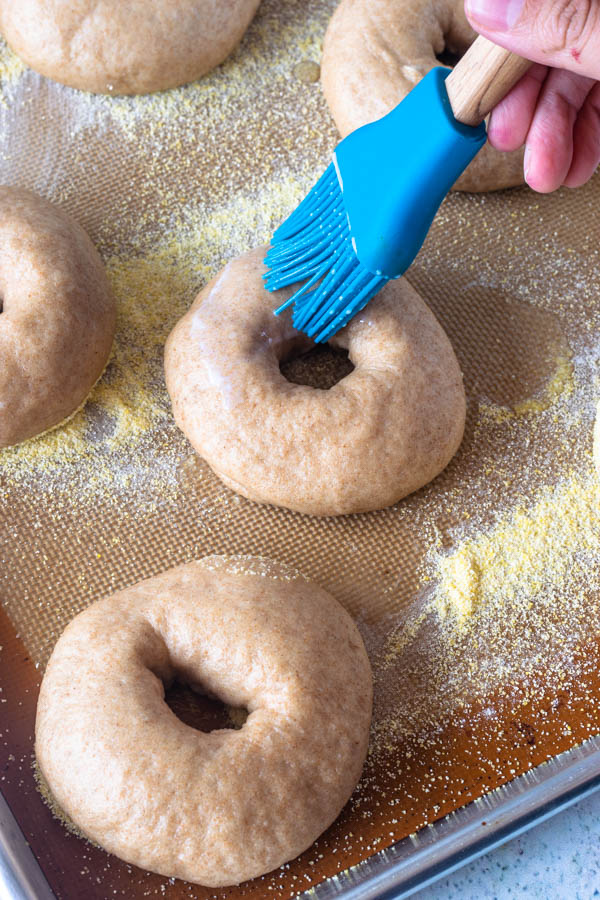
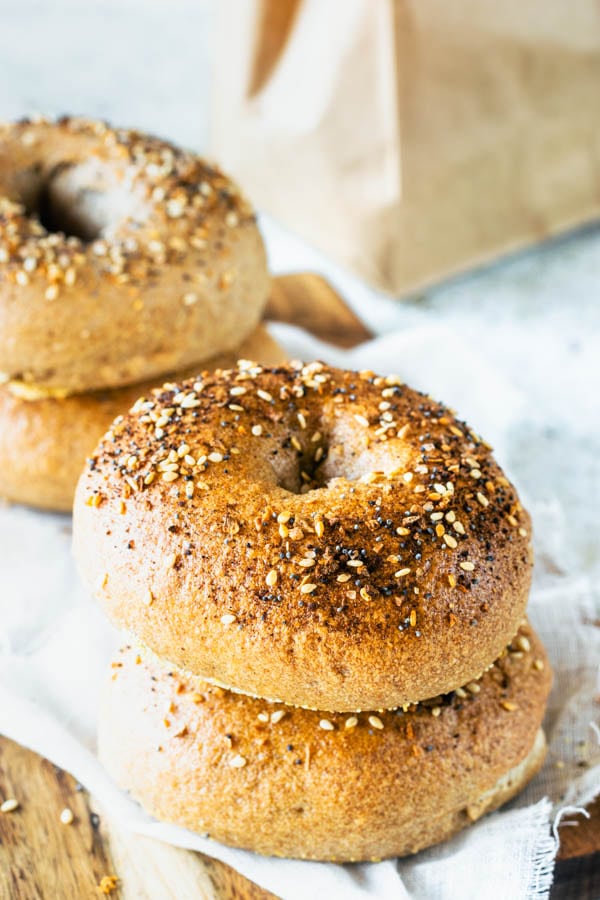
The bagels bake for about 10 minutes, then I rotate the pans and continue baking for another 5 to 15 minutes, depending on the oven and the size of the bagels. I pull them once they’re deeply golden and let them cool before slicing.
Expert Tips
Trust me, I’ve made these dozens of times now. Here are some great tips!
- This dough should feel stiff. A soft dough won’t give you proper bagel texture.
- Don’t rush the kneading. Gluten development is what makes these work.
- Keep the boil short. Longer boiling leads to an overly thick crust.
Variations I Actually Use
Aside from the Cinnamon Raisin version of these bagels, try the below variations…
- Cheese topping: Asiago is my favorite for a savory finish.
- Seed blends: Sesame, poppy, flax, sunflower, or fennel all work well.
Storage & Freezing
I like these best the day they’re baked, but they hold up well for a couple of days stored in an airtight container. I don’t usually go beyond that. For longer storage, I freeze them whole or sliced in a zip-top bag for up to two months. If they’re already cut, I go straight from freezer to toaster.ccumsan sed rutrum vel, dapibus et leo.
FAQ
Yes. I often bake them the day before and toast as needed.
That stiffness is what gives bagels their chew. A softer dough will bake more like bread.
Absolutely. That’s my preferred way to freeze them.
This is usually either low oven temperature or skipping the malt syrup.
More Sourdough Recipes
If you enjoyed these, you’ll probably like my sourdough cinnamon raisin bagels as well. It’s the same dough with a completely different feel, and it’s one of my most reliable sourdough bakes. If you like baking with sourdough, here are some other recipes you can check out. I also have been experimenting with some regular bagels and some high protein bagels. Check them out!
Tag Me!
If you make these bagels, I’d love to see them. Tag me on Instagram or leave a comment and rating below—it really helps, and I always enjoy seeing how they turn out in your kitchen.
Sourdough Everything Bagels
Ingredients
- 300 grams sourdough starter 1 1/2 cups, 10.6 oz.
- 295-350 grams warm water 90-100F (1 1/4 cup- 1 1/2 cup, 10-12 oz.)
- 1 tablespoon vegetable oil
- 1 tablespoon barley malt syrup or honey
- 2 1/2 teaspoons fine sea salt
- 3 cups all-purpose flour (13.5 oz, 382 grams)
- 3 cups whole wheat flour (13.5 oz, 382 grams)
- To boil bagels
- 1 tablespoon baking soda for boiling bagels
Topping
- 1/4 cup milk
Everything Bagel Seasoning
- 1 teaspoon sesame seeds
- 1 teaspoon poppy seeds
- 1 teaspoon dried onions
- 1 teaspoon dried garlic
- 1 teaspoon coarse sea salt I use Maldon
- 1 teaspoon Za’atar.
Instructions
- Start by mixing the sourdough starter, 1 1/4 cup of water, vegetable oil, malt syrup, sea salt, and flours together in a bowl.
- Mixture will seem extremely stiff. That’s ok. Just make sure all the flour is getting hydrated. If necessary, pour that remaining 1/4 cup of water in, if you see too much dry flour that won’t incorporate into the dough.
- Cover bowl with a damp towel and let dough sit for 10 minutes.
- Kneading: I would recommend a stand mixer to knead this dough. Or a lot of elbow grease.
- Bagel dough should be kneaded at least 7 minutes by machine, probably double by hand. And it’s a very stiff dough, so it’s not the easiest to knead.
- It’s very important that you knead this dough properly, so the bagels will have their proper texture and gluten development.
- At the end of kneading, dough should be smooth, but still pretty stiff and dense.
- Transfer dough to a lightly oiled bowl.
- Cover with a damp towel.
- Let it rise in a warm place for about 4 hours.
- If your place is cold, let it rise 5 hours.
- Transfer dough to the counter.
- I split mine into 100 g (3.5 oz.) pieces, and ended up with 14 pieces.
- Turn pieces into balls by rolling them against the counter, with your hand in a cup shape.
- Use the counter to push the dough against itself and turn into a perfect round.
- There are plenty of videos on youtube that show this technique properly. Very easy, and you’ll always end up with perfectly shaped rolls, bagels.
- Now that you’ve rolled all the pieces into balls, start by making a hole in the center of each ball with your finger. Expand the center out with your hands, by rotating the bagel as you shape the hole in the middle.
- Check pics above to see how I did it.
- Then, place bagels in 2 baking mat or parchment paper lined baking sheets.
- I put 7 bagels in each baking sheet.
- Cover both trays with a damp towel. Let them sit at room temperature for 1-2 hours.
- Once the dough is springing back as you touch it, means your bagels are ready to go.
- Pre-heat oven to 425F.
- Bring a large pot of water to a boil.
- Once water comes to a boil, add baking soda to the pot.
- Boil bagels in batches, being careful not to overcrowd the pan.
- You should boil bagels about 20 seconds on each side. I don’t like to boil them over 1 min total, or their crust might turn out too hard.
- Remove bagels with a slotted spoon after they have boiled about 20 seconds on each side.
- Place boiled bagels in a baking sheet, lined with parchment paper or a silicon mat, and sprinkled with semolina/cornmeal, if you’d like.
- Brush bagels with milk.
- Sprinkle with whatever seasoning of your preference. I used sesame seeds, poppy seeds, dried onions, dried garlic, coarse sea salt, and even some Za’atar I had in my spice cupboard. Za’atar is a tangy spice blend you will love, once you try it.
- I made a big batch of this seasoning to keep on my cupboard.
- I just keep it in a shaker, and shake on top of toasts and other savory goodies.
- After sprinkling your bagels with the seasoning, place trays in the oven.
- Bake for about 10 minutes. Rotate pans. Bake for another 5-15 minutes. It will really depend on your oven and what size bagels you decided to make.
- Once bagels have a deep golden color, remove them from the oven. Let them cool and enjoy them fresh. STORAGE: I like to enjoy the bagels when they are very fresh. That’s when they are the best. However, nothing wrong with leftover bagel toast in the morning. Keep bagels in an air-tight container for up to a couple of days, I wouldn’t go longer than that. You can also freeze them wrapped in foil and inside of a ziplock bag or freezer container for up to 2 months.
- For variations: For other variations, check out this Sourdough Cinnamon Raisin Bagels.
- For bagel topping ideas: Seeds (Sesame, poppy, flax, sunflower, fennel), cheese (asiago is a big favorite), coarse salt, spice blends.
Nutrition

Have made these a couple of times with each time better than the last. Made late afternoon, let dough proof on counter for a couple of hours then into the fridge until the next afternoon. Took dough out of fridge for about an hour, shaped & let proof at room temp (~20C/68F) for 4 hours. Perfect process for achieving super results. Best & easiest recipe ever. Thanks for sharing!
very nice thank you so much!!!!
Can I do a cold retardation overnight in the fridge after the final shaping into bagels? If so, do I still need to let them sit for 1-2 hours? And can I boil straight from the fridge? Or would they need to warm up first? Thanks.
You can, I’d let them sit on the counter for just maybe 20 minutes or so before boiling.
These are wonderful! My husband and I live in a NYC suburb and have excellent NY bagel places nearby. However, we’ve been living a hermit-like existence since the lockdowns began last March and haven’t ventured into a bagel shop (or had any bagels) for almost a year. These definitely hit the spot and would give our local bagel places a good run for their money! Can’t wait to have people over for a brunch (post-COVID) and serve these up!
Due to time/ingredient constraints, I varied from the original recipe in the following ways: I used mostly white flour (~4.5 Cups) with the remainder of bread flour that I had on hand (~1.5 Cups). I plan to try it with just bread flour next time. At step 21, after shaping the dough into bagel form, I left them in the fridge overnight (covered with plastic wrap). Instead of brushing them with milk, I used an egg wash (1 egg + 2 tsp water mixed together).
Brooke, I appreciate your comment! So happy that they have been working for you! Also love the adaptations! Thanks 🙂
Hi, I can’t wait to make these. Should you use active starter or sourdough discard.
The active starter!! Thank you Jasmine!! 🙂
I tried making these for the second time and ran into a problem… The first attempt they turned out perfectly but the second time they did not puff up like they did and should have last time. My starter is very active and I followed all steps and directions exactly but something went wrong and I don’t know what.
I have a question… so I tried making these for the second time and ran into a problem… The first attempt they turned out perfectly but the second time they did not puff up like they did and should have last time. My starter is very active and I followed all steps and directions exactly but something went wrong and I don’t know what.
Aw I am sorry this happened! Did you knead the dough properly? You mentioned the starter was active, have you done the floating test to make sure? Also, are you in a cold or warm place?
My first attempt turned out well. I used ½ bread flour and ½ whole wheat. The kneading was tough–the dough kept wrapping around the hook and then just turning around and around. They also got very dry when I was rolling them out–it’s very dry weather here. I solved that by spritzing the counter and the dough with water, that worked well. Next time I’ll try some flavorings.
Can I substitute malt with honey?
Yes you can!
I highly suggest putting rosemary and sea salt on top!
sounds wonderful! Thank you!
These bagels turn out so nice. Lighter than the store bought bagels but still the right texture. I followed in the instructions using the weight measurements rather than volume.
I am looking forward to making these again.
thank you so much!
Pretty sure this is going to be a fail for me. Measured all ingredients precisely, but dough was way too thin. Even added more AP and WW flour, but dough is definitely not stiff and dense. Bagels are shaped and rising, but they look really sad. Maybe my starter (100% saturation) was too thin? I’ll definitely see it through, as I’ve already gotten this far. But my expectations are extremely low at this point.