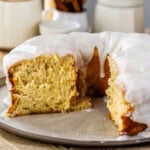
Glazed Donut Cake
This Glazed Donut Cake combines the soft, fluffy texture of a classic glazed donut with the ease of a sliceable cake. Inspired by German Butterkuchen, it features a rich yeasted dough flavored with nutmeg, finished with a buttery vanilla glaze that melts into every bite. The result is a tender, slightly chewy cake that tastes remarkably like a fresh bakery donut.
Servings 16 servings
Calories 390kcal
Ingredients
Dough Ingredients
- 4 cups + 2 tbsp all-purpose flour 500g
- 3¼ tsp active dry yeast 10g
- ½ cup granulated sugar 100g
- 1 tsp salt
- ½ tsp freshly grated nutmeg
- 1 cup whole milk lukewarm (220ml)
- 1 large egg
- 1 large egg yolk
- 1 tbsp vanilla extract
- 6 tbsp butter softened (85g)
Butter Topping
- 7 tbsp butter cold and cut into small cubes (100g)
- 2 tbsp granulated sugar
- ¼ cup heavy cream
Glaze
- 3 cups powdered sugar 360g
- 5 tbsp whole milk 75g
- 1 tbsp unsalted butter melted (14g)
- 1 tsp vanilla extract or vanilla bean paste
- pinch of salt
Instructions
Make the Dough
- In the bowl of a stand mixer, combine the lukewarm milk, yeast, and a couple tablespoons of the sugar. Let sit for about 5 to 10 minutes, until foamy.
- Add the remaining sugar, flour, salt, nutmeg, egg, egg yolk, vanilla extract, and softened butter.
- Using the dough hook attachment, knead on medium speed for about 8 minutes, until the dough is smooth and elastic.
- The dough will be somewhat sticky, but it should still be manageable. If it feels excessively sticky, sprinkle in a small amount of flour and knead gently. Avoid adding too much flour—the dough should remain slightly tacky.
- Lightly oil a large bowl. Transfer the dough to the bowl, turning it once to coat. Cover and let rise in a warm place for about 1 hour, or until doubled in size.
Prepare the Pan
- Generously grease either a 12-cup Bundt pan, or a 9x13-inch baking pan.
- You can also use a slightly larger rectangular pan, such as a 10x15-inch pan, if desired. The cake will simply bake up thinner.
Shape the Dough
- For a Bundt pan: Remove the dough from the bowl and shape it into a thick ring. Place it in the prepared Bundt pan and gently press it into an even layer.
- For a 9x13-inch pan: Transfer the dough directly to the pan and gently press and stretch it toward the edges. The dough stretches easily, so take your time working it into an even layer.
- Cover loosely and let rest for 20 minutes while the oven preheats.
Add the Butter Topping
- Preheat the oven to 350°F (175°C).
- Remove the cover from the dough. Using the handle of a wooden spoon, a spatula handle, or your fingertips, make dimples all over the surface of the dough, pressing about 1/2 inch deep.
- Scatter the cold butter cubes evenly over the surface, nestling some into the dimples. Sprinkle the sugar evenly over the top.
Bake
- Bake for approximately 30 minutes, or until the top is golden and the internal temperature reaches 195°F to 200°F (90°C to 93°C).
- As soon as the cake comes out of the oven, slowly pour or brush the heavy cream evenly over the entire surface.
- Allow the cake to cool in the pan for about 20 minutes.
Make the Glaze
- In a medium bowl, whisk together the powdered sugar, milk, melted butter, vanilla, and salt until completely smooth.
- If needed, adjust the consistency by adding a teaspoon of milk at a time. The glaze should be thick but pourable.
Finish the Cake
- Pour the glaze over the warm cake, allowing it to drip down the sides and settle into the surface.
- Let the glaze set for about 15 to 20 minutes before slicing and serving.
Storage
- Store leftovers tightly wrapped in plastic wrap or in an airtight container in the refrigerator for up to 5 days.
- For the best texture, remove the cake from the refrigerator about 10 minutes before serving. It stays remarkably soft even when chilled.
Notes
Yeast: Active dry yeast and instant yeast can be used interchangeably in this recipe. If using instant yeast, you can skip the proofing step and mix it directly with the dry ingredients.
Milk Temperature: The milk should be warm but not hot, ideally between 100°F and 110°F (38°C to 43°C). Hot milk can kill the yeast.
Flour: Measure the flour with a kitchen scale whenever possible for the most accurate results. Adding too much flour can make the cake dry and dense.
Nutrition
Serving: 1slice | Calories: 390kcal