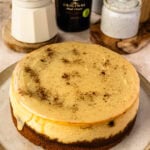
Bailey’s Cheesecake
This Bailey's Cheesecake features a buttery Biscoff cookie crust, a smooth and creamy Bailey's Irish Cream cheesecake filling made with white chocolate, and a silky Bailey's white chocolate ganache topping. Rich, decadent, and perfect for special occasions.
Servings 12 slices
Calories 685kcal
Ingredients
Biscoff Crust
- 250 grams biscoff cookies 1 package of biscoff cookies
- ⅓ cup unsalted butter 75g
Bailey’s Cheesecake Batter
- 1 cup chopped white chocolate 170g
- 4, 8 oz blocks of cream cheese room temperature (932g)
- 1 cup brown sugar 220
- ½ cup sour cream 120g
- ½ cup Bailey’s Irish Cream 120ml
- 4 large eggs room temperature
- ½ tsp espresso powder optional
- 2 tsp vanilla extract
- ¼ tsp salt
Bailey’s Ganache
- 1 cup chopped white chocolate 170g
- ¼ cup Bailey’s Irish Cream 60ml
- 3 tbsp heavy cream 45ml
- ½ tsp espresso powder to sprinkle on top-optional
Instructions
Biscoff Crust
- Pre-heat the oven to 325ºF.
- Place the biscoff cookies in a food processor and process to obtain fine crumbs.
- Melt the butter and pulse in with the biscoff crumbs.
- Press the mixture on the bottom of an 8” or 9” cheesecake pan. If using an 8” pan, it must be deep.
- Bake the crust in the oven for 10 minutes. Remove it from the oven and let it cool down.
- After the crust is baked and cooled, grease the exposed sides that will touch the cheesecake batter with oil spray or by brushing a bit with neutral oil.
Bailey’s Cheesecake Batter
- In a large bowl, beat the cream cheese for 2 minutes with a hand mixer at medium speed, until creamy.
- Add the sugar and beat for another 2 minutes at medium speed.
- Add the white chocolate and the sour cream. Mix until combined.
- Pour the Bailey’s in and mix. Scrape the bowl and beat for another 30 seconds.
- Add the eggs one at a time, mixing until incorporated before adding the next one. Make sure to scrape the bowl a few times during the mixing process. Avoid over mixing once the eggs are added, to prevent cracking of the cheesecake.
- Add the espresso powder, vanilla and salt, and mix to combine.
- Pour the cheesecake in the pan, over the baked and cooled crust. Some cheesecake pans, such as my own, require the sides to be greased before adding the batter in, or the cheesecake sticks, so I always spray the sides of my pan with oil before pouring the cheesecake batter in.
- Sprinkle about ¼ to ½ tsp of espresso powder on top and use a spatula or knife to swirl gently.
- Wrap the bottom of the pan with a few layers of foil.
- Place the pan in a larger roasting pan, and add hot water to the roasting pan, to form a water bath. This is very important so the cheesecake doesn’t crack.
- Bake the cheesecake in the pre-heated 325ºF oven for 60 to 70 minutes.
- To check if the cheesecake is done baking, give the pan a little wiggle, it should jiggle slightly in the center, but the edges should look set.
- Turn the oven off, and leave the cheesecake to rest inside for 1 hour.
- Remove the cheesecake from the oven and place it in the fridge for at least 6 hours.
Bailey’s Ganache
- Mix the heavy cream and Bailey’s together in a microwave safe bowl. Heat up the mixture until 175ºF, or until very hot in the microwave, before it comes to a boil.
- In a separate bowl, add the chocolate and then pour the cream mixture over. Cover and let sit for 1 minute.
- Mix with the ganache with a whisk until the chocolate is completely incorporated.
- Let the ganache cool down to a thick consistency before using. You can place it in the fridge to speed up the setting process, stirring every 5 minutes. This ganache is meant to be on the runny side. It sets nicely once spread on top of the cheesecake and refrigerated, and it can form nice ribbons as it drips down the sides of the cheesecake.
Decorate
- Spread the ganache on top of the cheesecake. Sprinkle with a bit of espresso powder. Serve!
Notes
Cheesecake Pan: I use the Fat Daddio 8″ springform pan. You can also use a 9″ springform pan with this recipe.
Mini cheesecakes: For adorable mini cheesecakes, bake the batter in cupcake tins. This recipe yields approximately 24 perfectly portioned treats, ready in about 25 minutes. Best of all, no water bath is required!
Crust: You can make a regular Graham Cracker Crust if desired.
Greasing the Cheesecake Pan: I prefer to grease the exposed sides of the pan after baking the crust. Greasing the pan beforehand often makes it difficult for the crust to adhere properly to the sides and can lead to a soggy crust.
Oven Temperature: When using a convection oven, it’s best to lower the baking temperature to around 300ºF. Keep in mind that baking times may vary. Bake the cheesecake until the center has a slight jiggle and the edges are fully set for perfect results.
Oven Thermometer: Using an oven thermometer is highly recommended to ensure accurate temperature measurement. Ovens are often inconsistent, and if the temperature is too low, the cheesecake will take much longer to bake. Conversely, if the temperature is too high, the cheesecake can crack due to overbaking. A thermometer helps you achieve perfect results every time.
Sour cream: You can use yogurt instead of sour cream if desired.
Nutrition
Serving: 1slice | Calories: 685kcal