

Salted Caramel Macarons
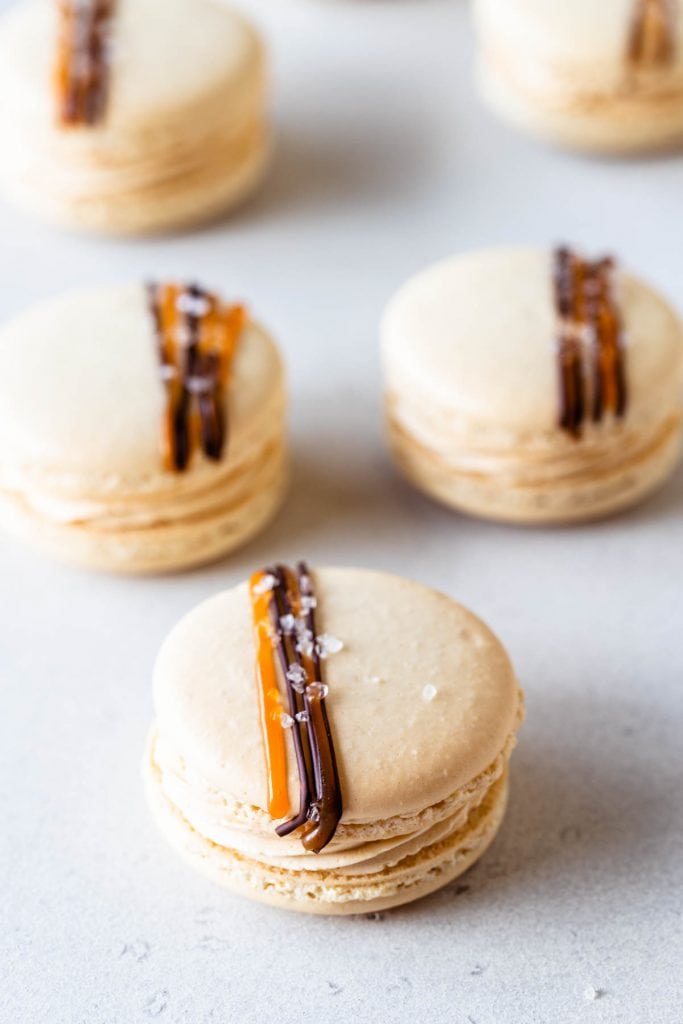
Hello friends! Today we are making Salted Caramel Macarons. These are some of my most popular macarons on the blog, and now there’s a video you can watch and see how I made them!
Watch the video on YouTube, or below on this page.
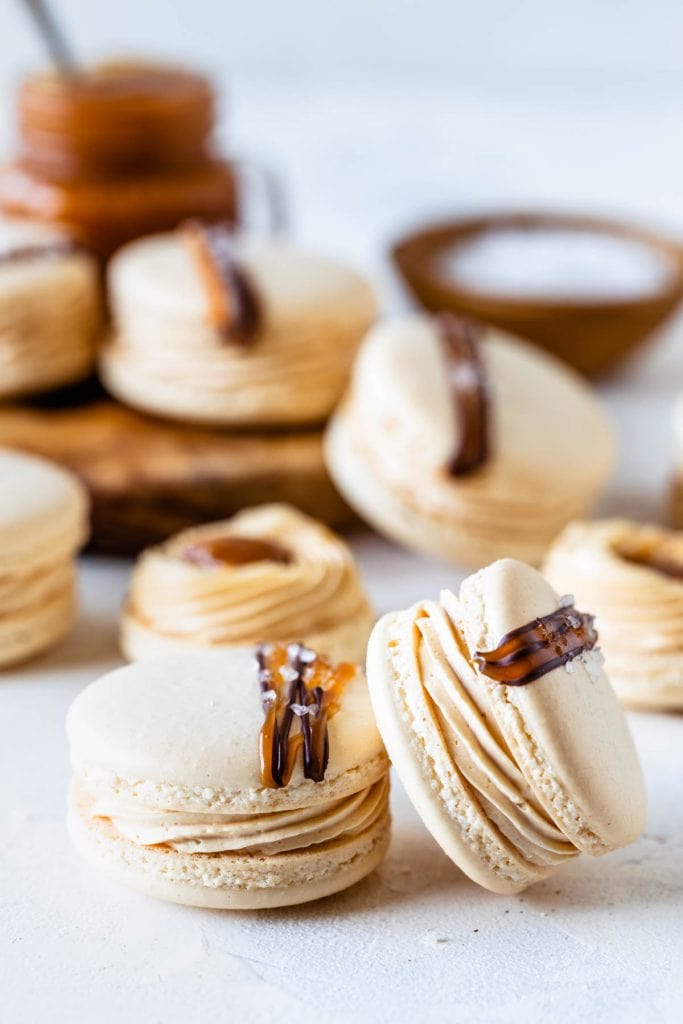
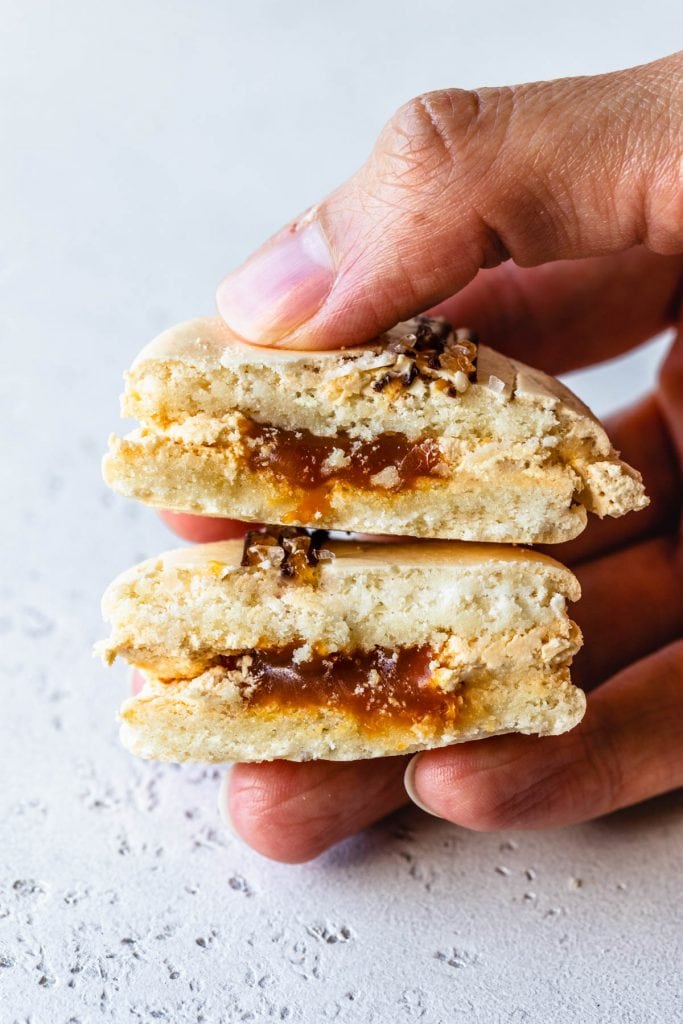
These Salted Caramel Macarons are filled with Salted Caramel Swiss Meringue Buttercream and Salted Caramel Sauce in the middle.
This post may contain affiliate links. I earn a commission from qualified purchases. Please read our Privacy policy here.
If you’ve made this recipe before, you will notice I’ve changed it. It used to be just the Salted Caramel Swiss Meringue Buttercream filling, and now I am actually adding the Salted Caramel Sauce in the middle as well, because it’s just so much more delicious!
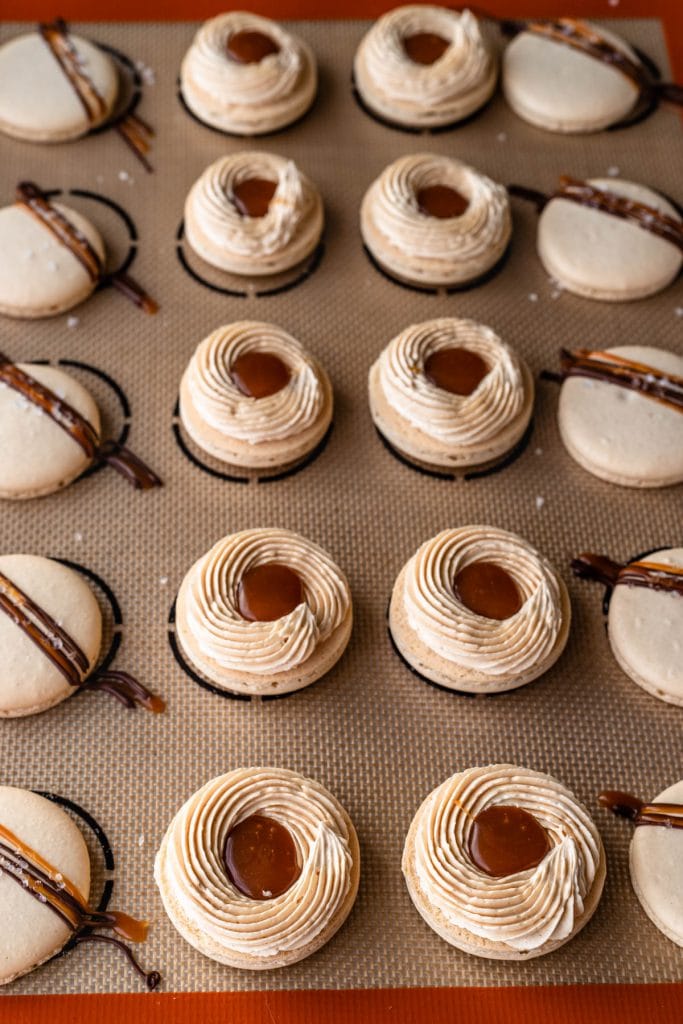
Let’s begin by talking about the Salted Caramel Sauce!
This is a quick easy salted caramel sauce, no thermometer needed.
But there’s a trick to it. You will cook this caramel sauce way less than you would a regular caramel sauce.
That’s because we are not making a water/sugar syrup when making the sauce.
Adding water to the syrup makes the caramel more stable in a way, and it takes a bit longer to make the sauce. However I find it that the chances of the caramel crystallizing, or even burning are higher. First because you can’t stir the water/sugar syrup, so it’s a bit more out of your control.
Anyway, trust me on this sauce. I’ve made it a thousand times, and it works every single time!
Just make sure not to overcook the sauce, so it doesn’t harden up after it cools down.
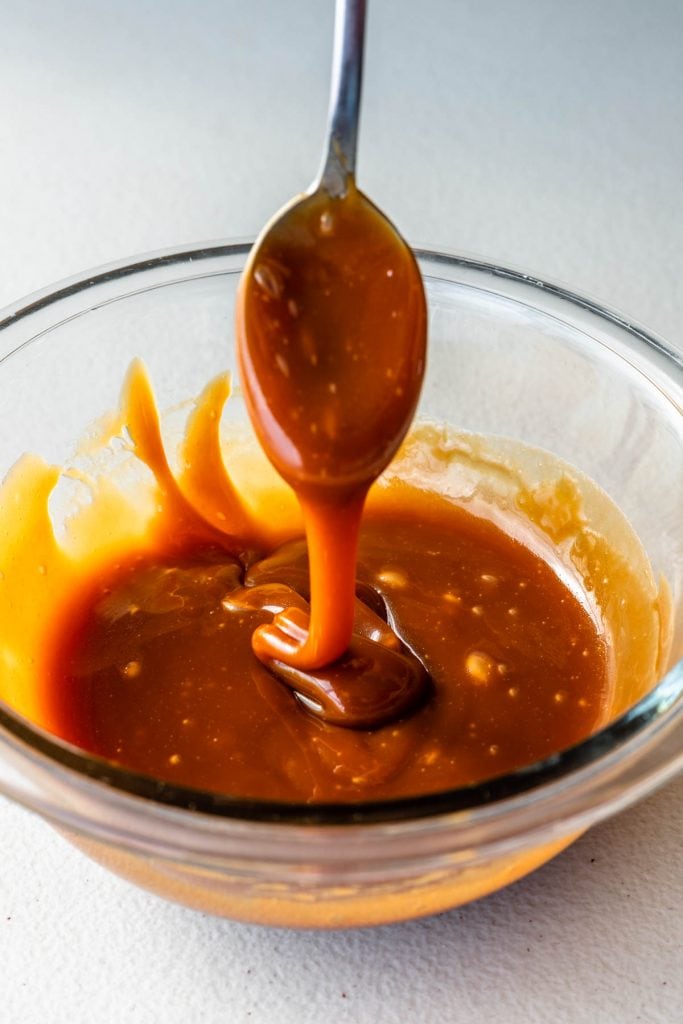
Tips for making the perfect Salted Caramel Sauce
- Begin by melting the sugar in a heavy bottom sauce pan. Stir the sugar at all times so it melts evenly.
- As soon as the sugar has melted, add the heavy cream. Don’t wait another second for the sugar to cook. That will make your sauce hard and bitter.
- Be careful when adding the heavy cream as the mixture will bubble up.
- When you add the heavy cream the sauce will crystallize, and THAT’S OK! Just keep stirring over medium-low heat, until the crystallized sugar melts again.
- Add the salt and butter, and stir the sauce over medium-low heat JUST until the butter melts. As soon as the butter melts remove from the heat. Don’t keep cooking the sauce. That will make the sauce hard when it cools down.
- If there are bits of crystallized sugar in the sauce, pour the sauce through a strainer after you take it out of the oven. But if you follow all instructions right, that shouldn’t happen. Though I understand sometimes we get distracted and don’t stir enough, or forget to lower the heat. It happens. And that’s a good way of fixing it.
- Use a heavy bottom saucepan. This is very important so that the sugar doesn’t burn and become bitter and crystallizes.
- Don’t use a whisk. Use a silicone spatula always! The metal whisk will crystallize the sugar.
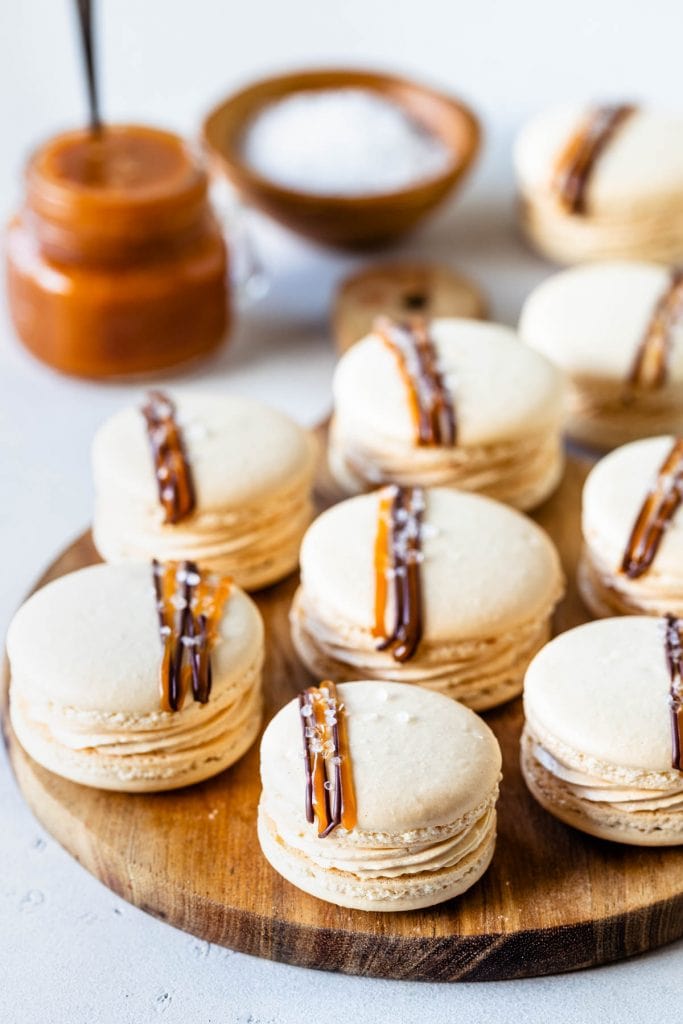
If you make this Salted Caramel Sauce and it hardens up, you can be sure it’s because you’ve overcooked it at some point.
But that factor aside, this is an extremely easy and reliable way of making caramel sauce and it’s my go-to!
Can I make the Salted Caramel Sauce ahead?
Yes, you can! You can make the Salted Caramel sauce ahead and then fill the Salted Caramel Macarons on the next day.
Keep the sauce in the fridge until then. And then microwave it for a few seconds at a time, stirring in between, to bring the sauce to room temperature. Don’t overheat it, as you don’t want to use hot/warm caramel sauce for the Swiss Meringue Buttercream, but you also don’t want it cold.
Always make sure the sauce is at room temperature before adding it to the frosting, and before filling the macarons.
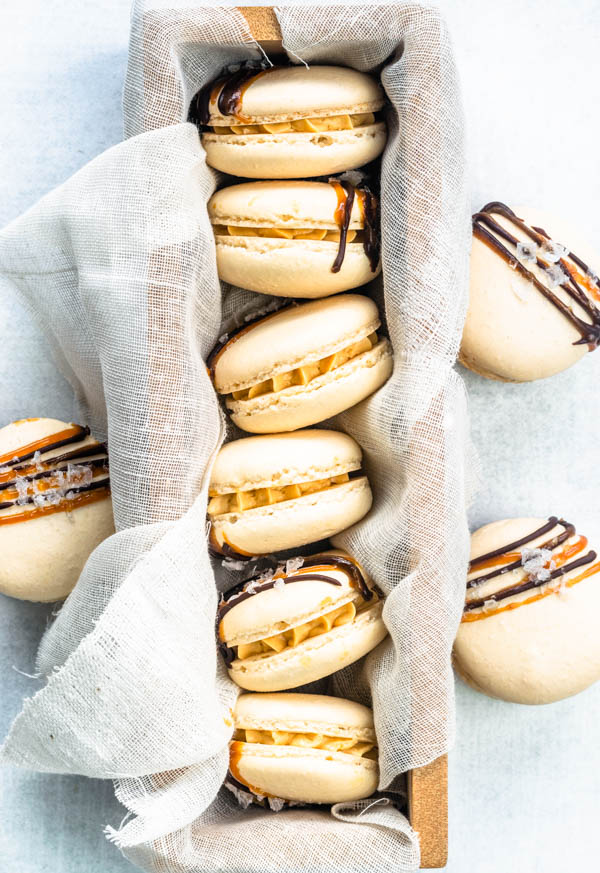
Alright, now we’ve covered the Salted Caramel Sauce. Let’s talk about the Salted Caramel Sauce Swiss Meringue Buttercream we used to fill our Salted Caramel Macarons!
This is one of the best frostings ever, one of my favorites!
Swiss Meringue Buttercream frostings is a great option for people who don’t like American Buttercream. Swiss Meringue Buttercream is lighter and less sweet than American Buttercream.
It takes a bit longer to make Swiss Meringue Buttercream as opposed to American Buttercream. But it’s SO worth it!
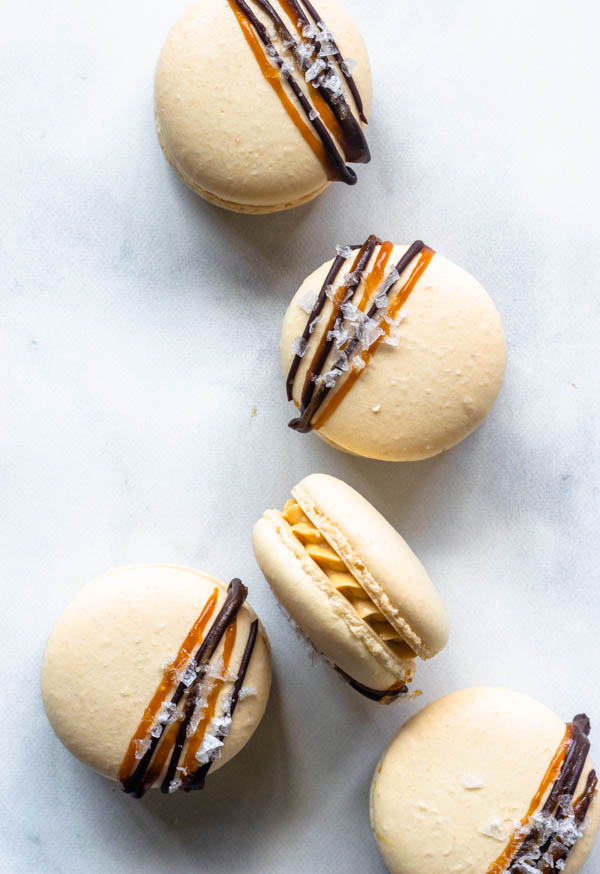
Tips for making the Salted Caramel Swiss Meringue Buttercream (and troubleshooting)
- Make sure the Salted Caramel Sauce has come to room temperature before adding it to the Swiss Meringue Buttercream.
- The butter has to be at room temperature. It can’t be too soft, and it can’t be cold. Remove it from the fridge 1 to 2 hours before starting to make the frosting, depending on how hot the kitchen is.
- If the butter is too soft, the buttercream will be too soupy and runny, and won’t come together. If that happens, insert the bowl with the frosting in the fridge for about 10 minutes, and then try whipping it again to see if it comes together and becomes thick, creamy, and fluffy.
- And if the butter is too cold, there will be lumps of butter in the buttercream, and it will be like biting into chunks of butter when you are eating the macarons.
- Make absolute sure to whip the meringue to stiff peaks. Failing to do so will result in soupy buttercream that won’t firm up or come together.
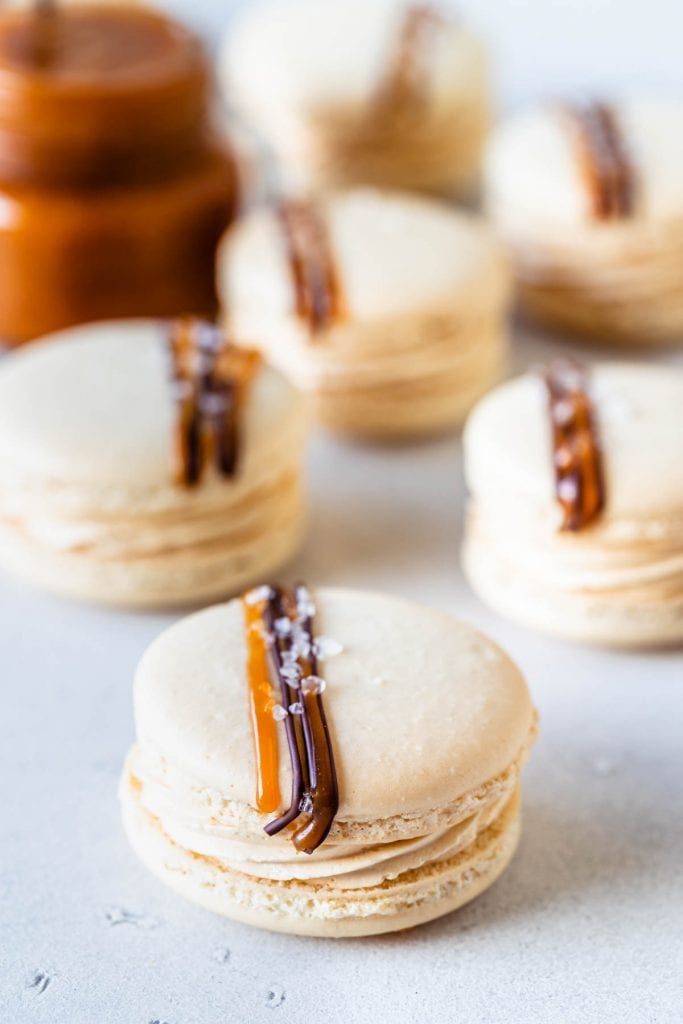
Can I make the Salted Caramel Swiss Meringue Buttercream ahead?
Yes, you most certainly can. This frosting will keep beautifully in the fridge and even in the freezer for a while. In the fridge for up to 5 days, and in the freezer for up to 1 or 2 months, making sure it’s well packaged.
Let it come to room temperature before using, and whip it until creamy and fluffy.
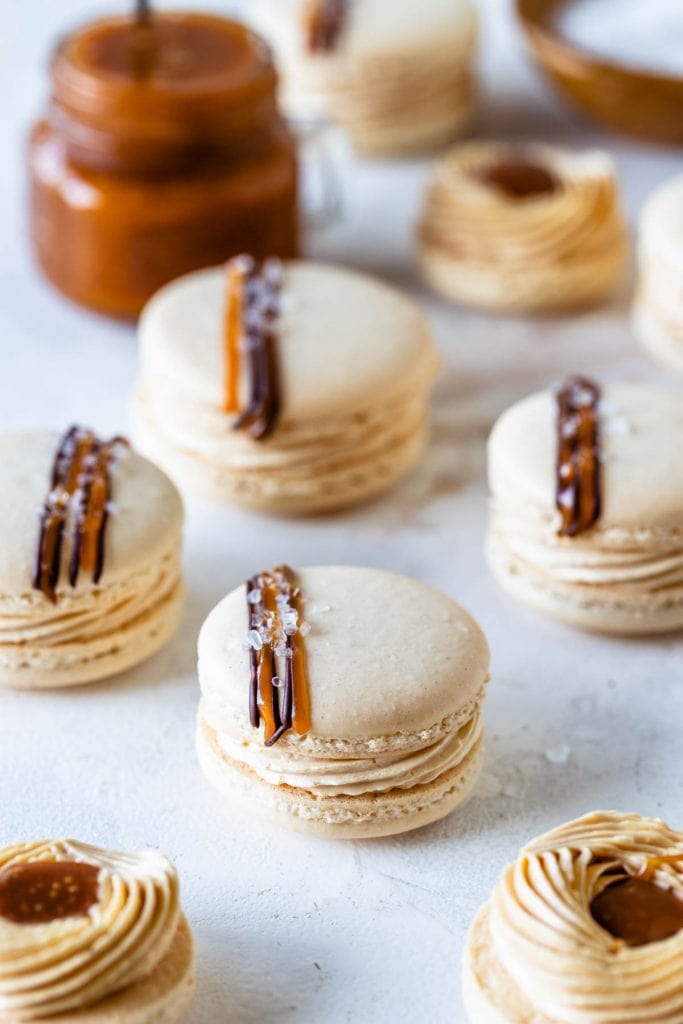
If you enjoy making macarons, I have a lot of posts and videos on YouTube that can help you!
Here are some posts with lots of macaron tips: Macaron Tips, How to Make Perfect Macarons.
And here are some more recipes you may enjoy:
- Tiramisu Macarons
- Cinnamon Toast Crunch Macarons
- Peanut Butter Chocolate Macarons
- S’mores Macarons
- Chocolate Caramel Macarons
- Coconut Macarons
- Chai Macarons
- Caramelized White Chocolate Macarons
- Pecan Turtle Macarons
- Nutella Macarons
- Dulce de Leche Macarons
- Chocolate Macarons
- Toffee Macarons
- Samoa Macarons
- Dulce de Leche Pecan Macarons
For the complete list of flavors and ideas, visit this page.
I hope you enjoyed today’s post. Thanks for reading! Tag me on instagram if you make my recipes, and also leave a comment below, it’s very helpful to me and all the other readers and bakers in this amazing macaron community!
Salted Caramel Macarons

Ingredients
Salted Caramel Macarons
- 100 grams egg whites
- 100 grams white granulated sugar
- 105 grams almond flour
- 105 grams powdered sugar
Salted Caramel Swiss Meringue Buttercream
- 2 egg whites
- 100 grams granulated sugar
- 10 tbsp unsalted butter (141 grams)
- 1/4 cup caramel sauce pre-made or recipe follows bellow
- 1/2 tsp vanilla extract
- 1/2 tsp salt
Salted Caramel Sauce
- 100 grams sugar
- 1/4 cup heavy cream (60 ml)
- 2.5 tbsp unsalted butter (35 grams)
- 1/2 tsp kosher salt
To decorate
- 40 grams dark or semi-sweet chocolate chopped finely, or chocolate chips
- 2 tbsp coarse sea salt
Instructions
Macaron Shells
- Before you start, get all of the ingredients ready. Prepare a large piping bag, fitted with a large round tip, I use a 1/2” diameter tip. Set aside.
- Line two baking sheets with parchment paper or silicone mat.
- I use a baking mat with the macaron template already in it.
- Measure out all of the ingredients.
- Sift the powdered sugar and almond flour together. Set it aside.
- Place the egg whites and granulated sugar in a heat proof bowl or in a double boiler.
- Over a pan of barely simmering water, whisk the whites and sugar until frothy and the sugar is completely melted. It will take a couple of minutes. You can test by touching the mixture between your fingers, and if you feel any sugar granules just keep whisking the mixture over the water bath.
- Make sure the bottom of the bowl isn’t touching the simmering water because you don’t want the whites to cook.
- Also, don’t overheat the sugar syrup, this may cause issues down the line, such as wrinkly macarons.Transfer the syrup to the bowl of a stand mixer.
- With the whisk attachment, start whisking mixture on low for about 30 seconds, then gradually start increasing speed to medium. Whisk on medium for one to two minutes, until the mixture is white and starting to become fluffy. Raise the speed to high for a few minutes until stiff peaks are formed. Best way to check this is to keep your eye on the whites. Once they get glossy and you start seeing streaks formed by the whisk, it might be time to stop.
- Best way to check this is to keep your eye on the whites. Once they get glossy and you start seeing streaks formed by the whisk, it might be time to stop.
- You don’t want to overbeat the mixture at this point, because you don’t want to add too much air to it. Just whisk until stiff peaks have formed.
- Whisk until stiff peaks have formed. When you pull your whip up, the peak should be stiff and shooting straight up, with possibly a slight bend at the top, but not bending to the side.
- Pour the sifted powdered sugar and almond flour into the stiff meringue.
- Start folding gently forming a letter J with a spatula.
- Add the food coloring at this point, if using.
- How to know when to stop folding the batter: It’s time to stop folding when the batter is glossy and has a thick and flowing consistency. There are several ways to test this.
- First, pick up some batter with the spatula and try to draw a figure 8 with the batter that is dripping off the spatula. If you can form several 8 figures without the batter breaking up, that’s one indication that it might be ready.
- There’s another test you can do. I call it the Teaspoon test.Grab a teaspoon of batter and spoon onto the parchment paper or silicon mat. Wait a minute to see how it behaves.
- If the batter stays stiff, forming a point and doesn’t spread out, fold a little bit more, about 3 folds.
- Test again.
- You don’t want your batter to be too runny either. So be careful not to over mix. It’s always best to under mix and test several times until the proper consistency has been achieved.
- When you hold the spatula with batter on top of the bowl and the batter falls off the spatula slowly but effortlessly the batter is ready. The batter will keep flowing off the spatula non-stop, but not too quickly.
- Once the batter spreads out a bit and starts to look glossy and smooth on top, on the parchment paper, it's ready.
- Transfer the batter to the piping bag.
- Place the piping bag directly 90 degrees over the center of each macaron template. Apply gentle pressure and carefully pipe for about 3 seconds, and then quickly pull the bag up twisting slightly.
- Once you’ve piped as many circles as you could, bang the trays against the counter a few times each. This will release air bubbles that are in the batter and prevent your macaron shells from cracking.
- Use a toothpick to pop any air bubbles in the surface of the shells.
- Let the trays sit for a while so the shells will dry out a little bit. I usually leave about 20-40 minutes, depending on how humid the day is. You’ll know they’re ready when you gently touch the surface of a macaron and it seems dry.
- Pre-heat the oven to 300ºF.
- Bake one tray at a time.
- Bake for 5 minutes, rotate the tray.
- Bake for 5 more minutes. Rotate again.
- I bake each tray for about 15 to 20 minutes.
- When baked, the macarons will have a deeper color and formed feet. If you try to move a macaron, it shouldn’t feel jiggly. If the macaron is still jiggly, keep baking.
- Remove from the oven and bake the other tray.
- Let the macarons cool down before proceeding with the filling.
Salted Caramel Swiss Meringue Buttercream
- Remove the butter from the fridge 1 to 2 hours before making the Swiss Meringue Buttercream. The butter needs to be softened, but not too soft. And it also shouldn't be cold. If the butter is too soft, the buttercream won't form, it will be too soupy and runny. And if the butter is too cold, it will form lumps in the buttercream that won't incorporate with the frosting, and then you will be biting into chunks of butter while eating.
- Place the egg whites and sugar in a bowl over a double boiler with barely simmering water.
- Whisk the whites and sugar until they temp 140F. Basically you are looking to melt the sugar granules, and also make it so the egg whites are in a safe temperature to be consumed.
- Once you achieve that temperature, remove from the double boiler, and begin to whip the syrup with an electric mixer on low speed.
- Gradually increase the speed to medium-high, and continue to whip until stiff peaks form. This can take a while because first the meringue will have to cool down to start forming the peaks.
- Make absolute sure to achieve stiff peaks with the meringue. If you don't achieve stiff peaks, the meringue might not form.
- Cut the butter into very small pats.
- Once the meringue has reached stiff peaks, begin to add one pat of butter at a time, whisking it completely into the meringue before adding the next slab of butter.
- This whole process could take about 15 minutes.
- Once you are done adding the butter, the buttercream should already be firming up, and getting thick and creamy. If at this point the buttercream isn't doing any of those things, you can be sure it's because the butter was too soft, or the meringue wasn't whipped enough.
- One way to troubleshoot it is to place the bowl in the fridge for about 10 minutes, and then try to whip it again.
- Anyway, once the whole butter has been incorporated, and the buttercream is thick and fluffy, add the Salted Caramel sauce, the vanilla, and the salt to the bowl.
- Whisk until completely incorporated.
Salted Caramel Sauce
- Place the sugar in a medium saucepan with a heavy bottom, over medium heat.
- Stir the sugar the whole time, while it melts. The sugar will begin to form a brown syrup, and you have to stir the whole entire time, to make sure it melts evenly. Otherwise, some parts of the sugar will burn, while others won't get a chance to melt.
- As soon as the last bit of sugar melts, immediately lower the heat to medium-low, and add the heavy cream.
- It's very important to not let the sugar cook too much or burn. If the sugar cooks too much at this point, the caramel will be hard once it cools down, or it will taste bitter.
- So as soon as you see no more bits of solid sugar, be quick and add the heavy cream.
- Be very careful when adding the heavy cream as it will bubble up and you don't want to get burned.
- As soon as you add the heavy cream, some of the sugar will crystallize, and that's ok. Continue to stir the heavy cream for 30 seconds, while the sugar re-melts, over medium-low heat.
- Once the sugar has re-melted, add the salt and the butter, and stir the mixture for another 30 seconds.
- As soon as you notice the butter has almost entirely melted in the caramel sauce, remove the pan from the heat. Continue to stir for another 20 seconds or so until the butter melts entirely. It is very important not to over cook the sauce at any point, or it will become too hard as it cools down.
- Pour into a heat proof container and let it cool down completely.
- If there are bits of crystallized sugar in the sauce, pour the sauce through a strainer after you take it out of the heat. But if you follow all instructions right, that shouldn't happen. Though I understand sometimes we get distracted and don't stir enough, or forget to lower the heat. It happens. And that's a good way of fixing it.
To assemble
- Melt the chocolate by microwaving it for 15 second intervals until melted and smooth.
- Place the chocolate in a piping bag and snip the end. Drizzle some chocolate over the top shells of the macarons. You could also use a spoon to do this.
- Do the same with some of the Salted Caramel Sauce. Place it in a piping bag and drizzle over the macarons. Then sprinkle some coarse salt on top.
- Put the Salted Caramel Swiss Meringue Buttercream in a piping bag. Pipe a ring of frosting around the edges of each bottom shell.
- Pipe a bit of the Salted Caramel Sauce in the middle of each buttercream ring.
- Place the top shell over the filling.
- Macarons are always best when consumed the day after they are made. Let the mature overnight.
- STORAGE: Store the macarons in a closed container, in the fridge, for 4-5 days. In the freezer, in an air tight container, for 1-2 months.
Notes
 is the Storage Container I use to store my macarons.
Caramel Sauce: Don’t overcook the caramel sauce. Don’t overcook the sugar, and don’t overcook once the butter has been added. Just cook the sugar until it melts, then immediately add the heavy cream, and once the sugar re-melts, immediately add the butter. And once the butter melts, turn it off. Overcooking the caramel will make it harden up once it cools down.
Swiss Meringue Buttercream: Make sure the butter is at room temperature. Not too soft, and not cold. Soft butter will make the buttercream runny, and cold butter will make the buttercream lumpy. Also make sure to reach stiff peaks with the meringue before adding the butter.
is the Storage Container I use to store my macarons.
Caramel Sauce: Don’t overcook the caramel sauce. Don’t overcook the sugar, and don’t overcook once the butter has been added. Just cook the sugar until it melts, then immediately add the heavy cream, and once the sugar re-melts, immediately add the butter. And once the butter melts, turn it off. Overcooking the caramel will make it harden up once it cools down.
Swiss Meringue Buttercream: Make sure the butter is at room temperature. Not too soft, and not cold. Soft butter will make the buttercream runny, and cold butter will make the buttercream lumpy. Also make sure to reach stiff peaks with the meringue before adding the butter.Nutrition

I made some of these as a holiday gift for my supervisor – I know she loves salted caramel. It’s not the first time I’ve made this recipe of yours. BUT I have to tell you this: She told me there’s a bakery in Fells Point, Md,, that specializes in macarons, but mine were better than theirs! Then she posted a photo on Instagram, just her hand holding one of the macarons between two fingers, and wrote that was the best macaron she’d ever had and tagged my Instagram page (freshfromsueskitchen). That’s all YOU, Camila! Thank you for such an incredibly recipe!
That was all you my friend!!! Macarons are hard to make, even with guidance, so you clearly did an amazing job!!!! I am so proud and honored that you used my recipe!!!! Thank you so much!🥰🥰🥰🥰
Does the egg have to be room temperature?
It doesn’t, because you are going to heat them over the double boiler with the sugar.
Hi, if I don’t have an oven thermometer what should I do? Will it ruin my macarons?
you should get one for sure. I dont even bake macarons if my thermometer is broken or if I dont have one. I constantly have to adjust my oven temperature while baking. ovens are never ever accurate at keeping the temperature you set it.
on this article i explain in detail why you must have an oven thermometer https://www.piesandtacos.comunderstanding-your-oven-macaron-tips/
My favorite salted caramel recipe period!! I learned how to make Macarons from your recipes. I’ve tried methods and always return to yours!!!
These turned out great exept for the caramel sauce. I had to make a double batch and the second time after I added the cream it became very chunky. I tried to mix it to blend it backk in and even after i added the butter and salt, it remained chunky. It was odd, as the first batch was perfect. Over all, amazing cookies!
Hi Camila! I’ve been trying your macaron recipes for the past two weeks now and i’m still not giving up!!! They’re so simple to understand and you always almost have the same proportions for each recipe. I was just wondering if the caramel sauce goes rock hard in the fridge, or does it stay thick and slowly-flowing? Also, would it be okay to use normal buttercream recipes with 1/4 cup of the caramel instead of using the meringue buttercream (as i’m a little paranoid about using raw eggs).
the caramel sauce will become hard in the fridge. place it in the microwave for a few seconds to bring it do a flowing consistency.
And yes you can use regular buttercream recipe instead of the swiss meringue. However, once you bring the egg whites to a certain temperature they will be safe to be consumed. However, if you still dont want to its totally fine to use in regular buttercream 🙂
This is my favorite macaron recipe I’ve tried and it was easy for me and my husband to follow. The only thing I’d say is we had SO much buttercream left over so maybe cut that recipe in 1/4. They are delicious though and we ended up just eating the buttercream we had straight out of the bowl.
I am so happy you like the recipe!! and you are absolutely right! I actually made it this week, I made a video and stuff, I reduced the recipe by half, and had almost no leftover buttercream! I will republish the new measurements along with the video soon! Thank you so much 😊
Can I use the french macaron technique on this recipe?
Meaning can I not cook the egg whites before whiping them?
some people do, I have never experimented with these measurements and the french method, but I have readers who have done it.
You saw my photos of your Salted Caramel Macarons on Facebook just the other day. I loved baking them! And those who have tried them have loved eating them, too. Here’s the big tell: I have a 26-year-old niece who is vegetarian and INCREDIBLY picky about what she eats. I sent some of these to her today, via her mom, my sister, Debbie. Deb wrote: “Melissa said these look very professional and they may be nudging out my peanut butter eggs for her favorite thing to eat! High praise indeed.” You better believe it’s high praise. Thank you for the amazing recipe!
That’s so awesome to hear!! Thank you Sue!! Your macarons looked amazing I definitely remember them!!! You did awesome!!!
These were really delicious. I had to watch a video on youtube on how to make sure your macaron batter is ready because I was just a bit confused by the directions. (Here is a link to the vid I watched: https://www.youtube.com/watch?v=iv9reKJ-uTI ) Everything else was pretty straight forward! Most of the macarons came out amazing!! The ones that were cracked on top still tasted fantastic with the buttercream and drizzles of caramel. Macarons are so soo hard to master, but I really like this method compared to the traditional French way.
Do I need to make two batches of the caramel sauce to have enough for the buttercream and for drizzling on top of the cookies? Or is one enough?
You’ll have enough 🙂
These macarons turned out amazing!! So decadent. And I had plenty of caramel sauce! Thank you!
That’s awesome to hear! Thank you so much!
Should I use the convection setting for my oven?
You sure can, but please decrease temperature by 30% (this is what a few bakers have recommended to me, I have never baked in a convection oven).
Should I age the eggs
I don’t do that. Some people say it helps, specially if you’re in a humid climate
Thank you for sharing! I was wondering if I could ship these or would the filling go bad?
this needs to be refrigerated. I wouldn’t ship it.
Thank you for your reply. Are there any fillings that are ok to ship?
Hi Camila! Thank you so much for the detail you’ve put in to recipe development and instruction!!!
I LOVED the buttercream for these macaron, though it took me awhile to get there. I had to try the caramel recipe four times before I got it right. For those of you doing some high altitude baking like myself, I worked out a few things that will help:
1. Ensure that your cream is HIGH FAT. This will not work with anything less than 30%. I ended up using a whipping cream that had added stabilizers, and this gave me the best result.
2. Follow the steps given in the recipe, but swap the addition of butter and cream. In Camila’s recipe, she notes adding butter + salt, then later adding cream. This recipe only worked for me when I added cream first, then butter + salt second. Think of it like a curd, in which the butter gets added at the end for ultimate emulsification.
The shells themselves also took a few tries to get right. I usually love this method, but the proportions here are very different from other recipes I’ve tried and loved that use the same method. I tried your method six times, and came up with the following recommendations for other high altitude bakers:
1. For the love of pizza, measure with a very accurate scale. It’s so important.
2. For the measurements as written, lean to the lower side of egg white weight. I used 90g egg whites / 100g sugar / 96g almond flour, 90g powdered sugar. If you have 120g egg whites, use 100g sugar / 110g almond flour / 100g powdered sugar.
3. Measure your almond flour AFTER sifting. If your almond flour is at all clumpy, do NOT push the flour through your sifter. Instead, add more almond flour until the sifted amount is correct to this recipe.
4. Measure the powdered sugar AFTER sifting.
5. Sift almond flour and sugar together again after you’ve sifted and weighed the correct amount.
6. Be patient with the batter and ensure you mix it to the right consistency. If you don’t, you’ll get either flat crispy discs or poofy mini-pavlovas (which were delicious, I must say!). Follow Camila’s cues or watch a bunch of youtube videos. At high altitudes, we will have to mix more delicately, but for longer than what many bakers recommend.
7. If you’ve followed everything perfectly and the recipe still isn’t working, get yourself an oven thermometer.
8. Start the oven at 325o, but bring it down to 300o after your meringues have risen and developed feet. Reheat top 325o before adding the next sheet.
Camila, when I finally got these down they were exceptionally delicious, and my husband’s favourite! I hope you don’t mind me adding some modifications here, but I noticed that other bakers were struggling as I did. This is not a failing of your recipe, but instead an indicator that macarons are temperamental little gems that need TLC and some major adjustment, depending on geography. Thank you for a great framework!